Wednesday, 27 February 2008

The Caste System


I have not love for appearances or for high castes. It is discipline that I love.-Sri Guru Gobind Singh Ji (Rehatnama Bhai Sahib Singh Jee)

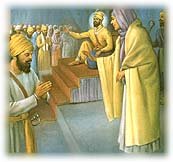
In sikhi no one is higher or lower due to their social status or wealth. It is our actions that will bring honour or dishonour in Gods court. Gods light is in all, so how can we be any different if our soul is the same. Sikhi eliminated caste when Sri Guru Gobind Singh Ji chopped of the heads from the 5 beloveds and put the heads on a different body and made them drink Amrit from the same bowl. (This proved we are all the same)

Recognize the human race as oneSri Guru Gobind Singh Ji Dasam Granth Ji


The caste System is a Hindu belief and it is causing disunity in the Sikh Community due to us not listening to our Guru.

  • People are building caste based Gurdwaras (Which is hypercritical)
  • There are problems when it comes to marriages.
  • It makes Sikhs feel isolated from other Sikhs.

Different sections (castes) of society develop hatred for one another and finish themselves through squabbles as the bamboos, due to their mutual friction, producing fire burn themselves as well as others. Bhai Gurdas ji varan

Recognize the Lord's Light within all, and do not consider social class or status; there are no classes or castes in the world hereafter. Ang 349 Sri Guru Granth Sahib Ji

No matter what background, culture, race, gender, country and tribe you belong to, remember we are all equal because Gods light is within us all.

Tribute to Shaheeds

MOTHER OF KHALSA

MATA SAHIB KAUR JI

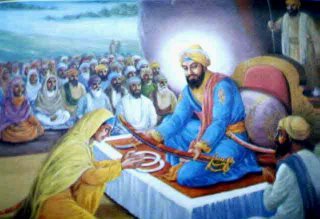
In Sikh history Mata Sahib Kaur is known as the Mother of the Khalsa. This honour was bestowed upon her by the Tenth Nanak, Guru Gobind Singh Ji. When a Sikh receives the gift of Khande Dee Pauhul (Amrit), he/she is told that from today onward your father is Guru Gobind Singh Ji and you mother is Mata Sahib Kaur Ji.

Mata Sahib Kaur Ji, whose name before taking Amrit was Mata Sahib Devan Ji, was born on the 1st November 1681 in a village called Rohtas, District Jehlum, in West Panjab, (now in Pakistan). Her mother’s name was Mata Jasdevi Ji and father’s name was Bhai Rama Ji. Her father, who was an ardent sewak (devotee) of Guru Gobind Singh Ji, influenced her to the extent that she wanted to devote her whole life in the service of the Guru Sahib. From her childhood, Mata Sahib Kaur Ji was a sweet and quiet natured girl. Because of the religious atmosphere at home, she was deeply influenced by Gurbaani during her formative years. It is possible that in her childhood she might have seen Guru Gobind Singh Ji at Sri Anandpur Sahib during the visit of her family.

"...She had inherited humility, love and sacrifice to humanity and devotion to Waheguru..."
Birth house of Mata Sahib Devan at Rohtas, Jhelum
When she came of age, her father and other devotees of village Rohtas, took her to Sri Anandpur Sahib and requested Guru Gobind Singh Ji to take her as his bride. Guru Ji told the Sangat that he was already married and could not marry again. However, Mata Sahib Kaur Ji's father had pledged his daughter to Guru Sahib and no-one else would marry her now. Therefore, Guru Sahib agreed that Mata Sahib Kaur Ji could stay with the Guru's family, however, they could not marry or ever have children.
Guru Sahib instead promised Mata Sahib Kaur Ji, that you will become a great Mother to thousands. Mata Sahib Kaur Ji lived in the Guru's household and served Guru Ji and the Sangat with full shardaa (devotion).
Mata Sahib Kaur Ji accompanied Guru Sahib throughout his life, even during battles, serving him in every possible way. On Vaisakhi 1699, in the first Amrit-Sanchaar, Mata Sahib Kaur Ji participated in the sewa of the Amrit-Sanchaar by adding Pataasey (sugar wafers) to the Amrit, and was bestowed the honour of eternal motherhood of Khalsa Panth.

Mata Ji guided the Khalsa Panth through period of crisis many times and issued eight decrees in the name of Khalsa.

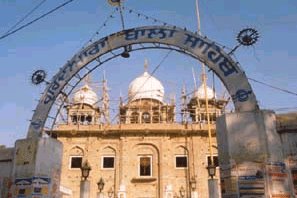
When Guru Gobind Singh reached Abchal Nagar (Sri Hazoor Sahib), he sent Mata Sahib Kaur Ji to Delhi and gave her five weapons of the Sixth Nanak, Guru Hargobind Sahib Ji, for safekeeping. These weapons are today displayed at Gurdwara Rakabganj in Delhi. Mata Sahib Kaur Ji, passed away before Mata Sundri Ji. She left for heavenly abode at the age of sixty six in 1747 and her last rites were performed in Bala Sahib, Delhi.

Gurdwara Bala Sahib, Delhi

Tyar per Tyar Khalsa

Guru Gobind Singh Ji gave the Khalsa the Amrit of the double edged sword. The khalsa is the army of God, its purpose is to practice truth and defend humanity. The khalsa stands for the principles of justice, righteousness and truth. The khalsa will die in the battlefield but never compromise theses principles. Guru JI said that his Khalsa should always be ready 24/7. (In other words never get caught slipping) Guru Ji gave the following commands to the Sikhs:

They are the Khalsa who fights valiantly in the direction of victory.

Thankhaanama Bhai Nand Laal Je

They are the Khalsa who is forever ready for battle.

Thankhaanama Bhai Nand Laal Jee

They are Khalsa who never runs from the battlefield and enshrines the warrior lifestyle in his heart.

Rehatnama Bhai Desa Singh

They are Khalsa who never abandons his weapon (Kirpaan). Recognise them as the disciplined and pure Khalsa.

Rehatnama Bhai Desa Singh

They are Khalsa who destroys the tyrant enemy.

Thankhaanama Bhai Nand Laal Jee


Outcry in South Africa!

Outcry in SA over 'racist' video
Screen grab from South Africa's ETV, allegedly showing black employees at a university being humiliated by white students
The alleged victims vomited after being made to eat fouled food

Several white students in South Africa face criminal charges after allegedly forcing black campus employees to eat food that had been urinated on.

A video has surfaced which appears to show the students instructing five elderly workers to drink beer and perform athletic tasks.

At one point, the University of Free State employees are apparently forced to eat food which has been urinated on.

The rector at the university has strongly condemned the video.

Students and staff joined a protest march at the campus in Bloemfontein, and student groups say they are now planning to call nationwide anti-racism demonstrations.

All these issues must be brought forward so that all the people of South Africa can see that racism is still a dominant feature in South African society
Siviwe Vamva
South African Students Congress

The video was reportedly recorded in protest at moves to integrate black and white students in the same residences at the University of the Free State.

The BBC's Mpho Lakaje says the university is known for having predominantly white students since the days of apartheid.

In recent years it has encountered difficulties trying to integrate people from other racial groups, and the latest incident is viewed by many as a clear indication of racial intolerance, he says.

'Upset'

The video shows five black people allegedly being instructed by a group of white students to down full bottles of beer, reports our correspondent, who has watched it.

A protest against an apparently racist video shot at a university in Bloemfontein, South Africa, on Wednesday
Students rallied near the campus, and other protests are planned

The university workers are then led to a playing field where they are told to display their athletic skills.

But it is the final extract of the film that has angered members of the public. It shows a white male urinating on food, and then - shouting: "Take! Take!" in Afrikaans - apparently forcing the campus employees to eat the dirty food, and causing them to vomit.

The alleged perpetrators are current or former students at the University of the Free State, say reports.

Its rector, Frederick Fourie, told the BBC that he was "extremely upset about the incident".

"We are having a management meeting. And there's a strong condemnation of this from everybody concerned," he said.

The university says it has begun procedures to suspend the students allegedly implicated in the video, and says the alleged victims have received psychological support.

Protests

On Wednesday, hundreds of black students and workers from the institution handed over a list of demands to management.

Map

Siviwe Vamva, from the South African Students Congress, said the group was planning to call a national strike on Thursday 6 March to raise the profile its anti-racism campaign.

He said racism was also still a problem in other universities.

"It's not only the University of Free State," Mr Vamva said.

"We are saying that all these issues must be brought forward so that all the people of South Africa can see that racism is still a dominant feature in South African society."

The South African Institute of Race Relations has said this incident and several others over the past month could threaten general improvements in race relations since the end of apartheid.

The institute also condemned the shooting of four black people by a white youth, and the decision by the Forum for Black Journalists to evict a white journalist from a meeting.

Tuesday, 26 February 2008

Father of the Khalsa!

Sri Guru Gobins Singh Ji had four sons; all four sons became Shaheed due to standing up for Sikh Principles. The elder two Baba Ajit Singh Ji and Baba Jujhar Singh Ji were killed in the battle of Chamkaur Sahib. The younger two were beheaded by the government because they refused to accept Islam. One day Mata Sahib Kaur Ji asked Sri Guru Gobind Singh Ji, whether he missed his sons?


Guru Ji Replied: You are wrong if you think I had only four sons, I have thousands of sons and daughters and in them I see the four I sacrificed. Those four sons were four virtues from Waheguru Ji, their body pots were to be smashed so that those virtues could be poured into the Khalsa.

Ajit means unconquerable, my Khalsa would rather die fighting than run like a coward.

Jujhar means warrior, my Khalsa is powerful and strong.


Zorawar means Power, as long as my Khalsa is distinct I will give them all of my power.


Fateh is victory, my Khalsa will fight for Waheguru's victory.


O Mata Jee, when I see one Khalsa with these 4 qualities I see all four sons.

The importance of Sri Sahib

History of RSS

Muslim terrorist convicted

A man said to be one of the most important recruiters for Islamist extremism in the UK has been convicted at the end of a major trial.

Mohammed Hamid, 50, of east London, was found guilty of training men in secret camps in the Lake District and New Forest to prepare them to fight abroad.

Among those to have passed through Hamid's camps were the four failed suicide bombers of 21 July 2005.

All four of the men responsible for the failed bombings were friends of Hamid.

The conviction marks a major success for counter-terrorism policing with Hamid regarded as a key figure in extremist networks.

Police say Hamid played a crucial role in grooming young men for terrorism and possible training overseas.

HAMID'S CO-ACCUSED
Atilla Ahmet, Kibley Da Costa, Kader Ahmed and Mohammed Al Figari
Clockwise from top-left:
Atilla Ahmet: Soliciting to murder
Kibley Da Costa: Attending terrorism training, providing training, holding terrorist articles.
Kader Ahmed, 20: Attending two training camps.
Mohammed Al-Figari, 44: Attending camps and holding terrorist articles.

Not pictured:

Hassan Mutegombwa
Mohammed Kyriacou
Yassin Mutegombwa


Hamid's training came in the form of camping trips around the UK and late night talks in the living room of his home.

Prosecutors said he sought to groom impressionable young men, a process that had only intensified after the July 2005 suicide bombings.

Hamid, 50, was found guilty of three counts of soliciting to murder and three counts of providing terrorism training. The jury at Woolwich Crown Court found him not guilty of providing weapons training at camps.

The jury cleared him of two further counts of soliciting to murder, relating to speeches, and a further charge of possessing terrorist articles.

Seven other men have been convicted in connection with his camps in a series of linked trials that have been under a partial reporting black-out.

Hamid and Ahmet will be sentenced at a later date.

Another man, Mousa Brown, was cleared of providing or receiving training.

During the trial, the jury heard that Hamid had close links to the leader of the 21/7 bombings, Muktar Ibrahim.

The lead bomber and four of his conspirators had joined one of Hamid's camps in the Lake District in the spring of 2004, the trial heard.

He and Hamid had also worked the same preaching stall in central London in 2004, leading to their arrest after a row with a police officer. Hamid told the arresting officer he was "Osama bin London" and armed with a bomb.

MOHAMMED HAMID
Mohammed Hamid
Born 1957, Tanzania, to Indian family
Grew up Batley, Yorkshire
Moved to London aged 12
Various manual jobs
Sent to borstal
Jailed for robbery
Two marriages, five children
Reformed crack addict
Found religion in 1990s


On the evening after the 7/7 suicide attacks Hamid had texted one of the men who would two weeks later try to blow himself up.

The trial heard that Hamid had been preaching for up to 12 years around London, including at Speakers' Corner in Hyde Park, his east London home and in his Islamic bookshop.

An undercover police officer codenamed Dawood later infiltrated Hamid's gatherings and recorded him and Ahmet encouraging young Muslims to fight.

Hamid had denied radicalising young men and claims he was running a "drop-in club" for al-Qaeda. He said that while hundreds of young men had come into contact with him over the years, he was trying to offer them support because Muslims were vulnerable in the wake of 9/11.

Acting Assistant Commissioner Peter Clarke of the Metropolitan Police praised the jury for seeing through Hamid's jokey personality.

"If you want to judge how serious Hamid, Ahmet and the others were, you just have to look at the group," he said.

"The group included the people responsible for the attacks in London on 21 July 2005. You have to look at the fact that they celebrated the deaths that occurred on 7 July.

"And in fact what they were doing accelerated and intensified to try to mount attacks both here and overseas.

"You can only possibly conclude that these were serious determined terrorists."

Monday, 25 February 2008

The Power of Amrit


When Bhai Jaita Ji (who became Bhai Jeevan Singh after taking Khande-ki-Pahul) came from Delhi bringing Guru Tegh Bahadar Ji's severed head to the tenth Guru, Gurujee asked, "Oh Bhai Jaita, tell how many people gathered at Chandi Chownk, to see my father be beheaded?"

Bhai Jaita Ji replied, "There were hundreds and thousands."

Guru Ji then asked, "How many Sikhs of Guru Nanak were standing in the crowds?"


Bhai Jaita Ji with tears in his eyes replied, "O Guru Ji, I couldn't recognise who was a Sikh or who was not a Sikh, there were thousands of people but I couldn't see any Sikhs distinct from the crowd."


The Tenth Guru, replied, "Don't worry! I will soon give the Sikhs, such a beautiful distinct image that my Sikhs will be recognised in crowds of thousands and throughout the world."


Amrit derives from two words, 'Am' and 'Mrit'.
'Am' means water. 'Mrit' is making a dead person alive.
Amrit', the water or nectar, which makes a dead person alive.


When Guru Gobind Singh Ji gave the Sikhs the Amrit of the Khanda Bata, he made the spiritually dead people alive, he instilled a new lease of spirit, which transformed sparrows into hawks, foxes into lion, and made the Sikhs fearless of death. Sikhs became part of the Khalsa army and resisted against injustice and sacrificed their lives in battles against opression and tranny.

In 1739, Nadir Shah came from Afghanistan to invade, plunder and loot the land of India.


As the army entered through Panjab, the Sikhs would attack the armies at night time.
The Sikhs would raid their looted wealth and riches.
The Sikhs would free the innocent Hindu sisters and mothers and return them to their respective homes.

Nadir Shah asked Zakriya Khan (hostile person towards sikhs), the Governor of Panjab, about the Sikhs. "Who are these people who dare to attack my soldiers and plunder me?", he asked.

Zakriya Khan replied, 'These are the followers of a man called, 'Guru Nanak'. Their homes are their saddles and they visit their holy shrine in the middle of the night only to disappear before the first light of day.'

Nadir Shah asked, "What gives them the strength to dare to challenge me and my large armies?"

Zakriya Khan replied, "Their Guru has given them Amrit, 'the nectar of immortality'. Drinking this they become fearless of death."

Nadir Shah with curiosity said, "How do you know this?"

Zakhriya Khan replied, "Those people who used to walk pass me, with their head down and would say "Salam"… Those same people after taking Amrit, still walk passed me, but now they don't hold their head down, nor do they say "Salam". Instead they walk past, looking into my eyes. You are one King, but they are all Kings."

Such is the power of Amrit!

If an old man takes Amrit he becomes fearless of death, like Baba Deep Singh Ji who at the age of 75 died fighting with his head on his hand.

If a young child takes Amrit, he becomes fearless of death, like Sahibzada Baba Zorawar Singh, who at the age of 8, didn't lower his turban to Wazir Khan and instead was bricked alive with his younger brother aged 5, Sahibzada Baba Fateh Singh Ji.

If a woman takes Amrit, she becomes fearless of death, like Mata Bhag Kaur Ji who led 40 Sikhs into victory in battle against an army of thousands.

Would you stay Nir-gura (without a Guru) till you die?

Or would you like to take the spiritual life-giving gift of Khande-ki-pahul, Amrit of the double-edged sword, and become the Sikh of the Guru, declaring allegiance for solely Sri Granth Sahib Ji and the Guru Khalsa Panth?

Have you felt the 'Power'?

How to meet waheguru


One day gursikhs called Bhai Bhagvaan Daas, Bhai Bodla Malik, Pirthee Mal, Dalloo Bhagat, Shyaam Daas and Sunder came to the darbar of Guru Hargobind Sahib. They did matha tek to Guru Sahib and pleaded before Guru Sahib to show them the way to swim across this terrible ocean i.e. unity with Vaheguru.


It is written in the Sikh history that Guru Sahib gave them the following lessons to attain unity with Vaheguru:

1) Make a dharamshaala (Gurdwara) in your town.
2) Get up at amritvela and assemble at the Dharamshaala.
3) Do Naam abhyaas during amritvela.
4) After Naam abhyaas recite Gurbani.
5) Then spend some time to discuss and interpret the meanings of Gurbani.
6) Perform ardaas at the end of the diwaan.
7) During the day earn your living through honest means.
8) Never subscribe to dishonesty and fraud.
9) During the evening time assemble at the Dharamshaala.
10) Recite Rehraas Sahib and do kirtan.
11) After ardaas return to your homes and sleep after doing Sohila.
12) Help out poor people who need help.
13) Celebrate Gurpurabs.
14) Keep your mind humble and kill your ego.


The Sikhs who had done benti obeyed the hukams of Guru Sahib and this is how they swam across this terrible ocean of life and death.

The Power of Gurbani

All of Gurbani is a magic potion sent directly from God to us mortals through the light of Guru Nanak Dev Ji. Gurbani touches the soul and purifies our whole being taking us from the darkness to the light. Each shabad touches our soul and emotions in different ways. That is why most of Gurbani is in Raags to emphasise on the feelings created by the shabad. Gurbani is a healer of the soul and is the only medication that will get us out of darkness.

The real purpose of Gurbani is to get you in union with God but each bani has a set focus and mood:

Jap Ji Sahib: All wisdom of Sri Guru Granth Sahib Ji is in this Bani, it helps strengthen our soul. (Just like a person doing training with weights gets stronger, the more Jap Ji Sahibs you do the stronger your soul will become)

Shabad Hazaare: When you feel lonely or separated from God, recite this bani to give you peace.

Jaap Sahib: This bani increases our vitality, courage, power, strength and self-esteem.

Tav Prasad Swaiya: When you feel unsatisfied, read this bani to reverse the mood and feel content.

Chaopaee Sahib: When you feel you are in danger, or you feel weak against the dark energies of life, read this bani to receive protection.

Anand Sahib: This bani is a soothing healer bringing bliss and happiness to your soul.

Rehiras Sahib: This is to be recited in the evenings to add energy to our being.

Kirtan Sohila: This Bani removes the fear of death, it also eliminates negativity around our being.

Sukhmani Sahib: This bani brings peace and comfort to our mind. Listening to Sukhmani Sahib once a day can change our destiny from misery to prosperity.

I have just narrated Some compositions that Guru Ji has written for inspiration and support for us mere mortals… buts it’s up to us to read them and experience the benefits for ourselves!

Sunday, 24 February 2008

Shaheed Bhai Ajit Singh Ji

Bhai Sahib was born in a small village in district Jalandhar. From childhood he was a very keen and focussed person. He grew up to be a very handsome, tall young man. He joined Indian Air Force in the fifties. There he met Bhai Tejinder Singh who was a well known Singh of Akhand Kirtani Jatha. Bhai Sahib Randhir Singh jee had not left this world yet and was physically alive. Bhai Tejinder Singh jee gave Bhai Ajit Singh jee some books to read on Sikhi.

TAKING AMRIT

After reading these books, Bhai Ajit Singh jee totally changed and expressed his desire to become a Sikh of Guru Nanak Dev jee. He wanted to meet Bhai Sahib Randhir Singh jee. He met Bhai Sahib and in the mid 1950s he took amrit at an amrit sinchaar organized by the Akhand Kirtani Jatha. After taking amrit, he used to get up at 1:30 am and his nitnem ended at around 7am. All day long too he kept reciting baani or Naam.

UNCOMPROMISING ON GURMAT

He never compromised on the principles of Gurmat. One of the most striking fact is that he did his military service in Air Force without tying his beard. It is totally unheard of but Bhai Sahib kept his rehit. In those days there was a Muslim senior officer whose name was HT Latif. Latif gave Muslims a special permission to maintained trimmed beard. Bhai Ajit Singh jee took a copy of the order of Latif that a religious Muslim is allowed to keep short beard. This letter greatly helped him in his service in Air Force.

Once there was a medal ceremony where Bhai Sahib showed up in his flowing beard. The Hindu officer who was distributing the medals, took a note of Bhai Sahib’s beard and asked him to tie it. Bhai Sahib refused and explained to him that it is his religion to maintain flowing beard. The officer took offense and threatened to take action if he did not obey orders. At this Bhai Sahib showed him a copy of the order of Latif, where he had allowed religious Muslims to maintained beards. Bhai Sahib said that he too was a “Maulwi” of Sikhs and wanted to keep a flowing beard. As much as the officer did not like this but he had no choice but to let him off because Latif was a much senior officer at that time. Guru Sahib kept Bhai Sahib’s honour.

Once a senior officer started smoking in the presence of Bhai Ajit Singh jee. Bhai Sahib requested him to stop smoking. He got offended as he did not expect a junior officer to tell him what to do. Bhai Sahib again requested him but the officer did not care and spoke rudely at him. He went as far as breathing smoke towards Bhai Sahib. This was too much for Bhai Sahib to sustain. He held his hand and forcefully stopped him from smoking.

The senior officer immediately ordered that Bhai Sahib be arrested. He was arrested and put in jail. Preparations for court martial were started. Some senior Sikh officers found out about this event. They explained to the other officers that this case could take a political turn if Bhai Sahib was prosecuted. Finally Bhai Sahib was released and he joined his service again. He did not apologize for his act and was willing to sacrifice for this act.

Bhai Sahib was very close to Shaheed Bhai Fauja Singh jee. Bhai Sahib used to stay at his house all the time and vice-versa. Bhai Sahib had great spirit for the chardi kala of Khalsa.

POST 1984 LIFE

After the rise of the militant movement of the Sikhs, Bhai Sahib’s house became a main stay for the militant Singhs. They used to stay at his house all the time. Being a Khalsa, he could not refuse anyone from staying in his house. He served them with his mind body and spirit. Famous Singhs who used to stay with him were Shaheed Harjinder Singh Jinda, Shaheed Manbir Singh Chaheru, Shaheed Balbir Singh, Bhai Mahal Singh, Shaheed Labh Singh and many others.

Everyone knew that the consequences of letting the militants stay at your house meant total destruction. Despite knowing this, Bhai Sahib never cared for the consequences. He did not care that his 3 sons and a daughter too could be victimized for this. He was worried about a higher cause. He wanted to serve the Khalsa of Guru Gobind Singh jee and he was willing to sacrifice himself for this.

On July 1986 arrived when Bhai Sahib was arrested by CBI for helping the militants. He was taken to the infamous Tihar Jail of Delhi. He was severely tortured there. He stayed there for 9 months and in these nine months all efforts were made to make him incapable of doing any more sewa of Panth. They could not kill him as he was an officer in the Air Force but they made him into a living dead i.e. turned him into a harmless person for them. He used to narrate how he was made to witness tortures of other gursikhs. These gursikhs were tortured in front of him and then killed in fake encounters. One famous Singh who was killed this way was Roshan Lal Bairagi a Sikh who had converted from the Hindu faith.


Bhai Sahib was given electric shocks that greatly effected him. Electric shocks were given to his head and even to his private parts. He was severely tortured. They also used to give him injections and after those injections, he felt that his hands and feet used to start shaking. By the time he came out of jail, he had developed some fatal disease as a result of this torture. Because of this shaking of his hands and feet, he fell down a flight of stairs one day and fell into a coma. He stayed in this coma for about 6 years untill June 5, 2003. He breathed his last on that day.

What is a sehaj Pahtt


A sehaj pahtt is reading Sri Guru Granth Sahib Ji in order from start to finish in a pace that suits you. For example you can read two Angs in a day and then the next day read 10 Angs etc. Ideally a Sikh is meant to complete a Sehaj path of whole of Sri Guru Granth Sahib Ji once a month. But if that is not possible even few Angs a day is will take your soul to next levels. Once you have completed a sehaj pahtt, it is to be started again; in this way throughout your whole life you will be doing darshan of Sri Guru Granth Sahib Ji. There are no excuses we all have access to Guru Ji through the net and if you don’t know Gurmukhi read the English translations.

http://www.sikhnet.com/sggs/translation/

Sword of the Sikhs


Sri Guru Nanak Dev Ji, the first Guru of the Sikhs, was born with the spiritual wisdom. This sword was used to destroy false rituals and beliefs which would never lead to union with waheguru. With this sword he denounced religious thugs and condemned ruthless kings and ministers as they were never condemned before.

You hold in your hands the sword of the Guru's spiritual wisdom; with this destroyer of death, kill the Messenger of Death. Ang 235 Sri Guru Granth Sahib Ji

Guru Angad Dev Ji, the second Guru of the Sikhs was given the sword of Spritaul wisdom, just like a candle lights another candle.

Nanak placed the umbrella of sovereignty on the head of Angad. He also graced the heart of Angad with the Mighty sword (Khaddag) of divine wisdom. Ang 966 Sri Guru Granth Sahib Ji

Guru Arjan Dev Ji, the fifth Guru of the Sikhs used martial metaphors in his shabads, he used these to arm his disciples with the sword of spirit. Without which no battle can be fought.

In His Mercy, God has blessed me with the sword of spiritual wisdom; I have attacked and killed the demons (Dark energies within us). Ang 1072 Sri Guru Granth Sahib Ji

Guru Hargobind Sahib Ji the 6th Guru , at the age of 11 put on two swords. One representing spiritual sovereignty (piri) and the other representing political sovereignty (miri). He showed the Sikhs to fight for both religious and political freedoms, religion without political freedom and dignity was abject slavery, and politics without religion was organised barbarism.

Guru Gobind Singh Ji, the 10th Guru, stated that the sword was the symbol of Wahegurus power, Justice and saving grace through which he protects the virtuous and punished the wicked.

Sword that smiteth in a flash

That scatters the armies of the wicked

In the great battlefield

Thou are the symbol of the brave

Thine arm is irresistible thy brightness shine forth

The blaze of thou splendour dazzling like the sun

Sword, thou are the protector of the saints

Thou are the scourge of the wicked

Scatterer of the sinners, I take refuge in thee.

Victory to thee, sword: the savoir and sustainer

Victory to thee, Sword, supreme sword.

Bachitter Natak, Dasam Granth.